What We Heard Report: Stakeholder Survey on the Initiative to Take Action Against Gun and Gang Violence (ITAAGGV) 2024-2025
On this page
- Overview and Approach
- Discussion of key themes
- Implementing stakeholder feedback
- Conclusion
- Annex A – Intervention module
- Annex B – Selected resources shared by stakeholders
Overview and Approach
In the spring of 2025, Public Safety Canada (PS) launched the second annual Stakeholder Survey on the Initiative to Take Action Against Gun and Gang Violence (ITAAGGV). Following feedback from the first survey, PS updated the second survey to provide clearer instructions with revised questions, updated the list of invitees, and added new content.
This survey is a direct consultation between PS and stakeholders. This ongoing consultation is required in order to remain responsive to our partners' needs under the ITAAGGV and to ensure that the implementation of programming proposals are well-informed. It is essential that PS continue this dialogue with stakeholders as policies and programs continue to evolve alongside gun and gang issues across Canada.
PS sought responses from key stakeholders involved in gun and gang initiatives across the country, including the following organizations:
- ITAAGGV portfolio partners (CBSA/RCMP)
- Other government departments
- Provincial/territorial governments
- Law enforcement
- Municipal governments
- Community organizations / Non-governmental organizations (NGOs)
- Indigenous governments / Indigenous communities
- Academia
Organizations were emailed directly from a generic inbox and surveys were to be completed via an online platform. Respondents had the opportunity to provide recommendations to PS on how to best engage with stakeholders under the ITAAGGV and how to improve resources for their respective organization(s).
Updates were made to the first survey, including the addition of questions focusing on supports needed to strengthen intervention work. The format of the questionnaire remained the same as the previous year, with the addition of five (5) questions. This What We Heard Report provides an overview of the feedback received through the survey from over 60 organizations.
The survey was closed to responses in June 2025. PS will open the third cycle of the survey to stakeholders in early 2026.
Discussion of key themes
Demographics
Respondents were asked to identify the type of organization they represent, broken down as follows:
- Federal government (3%)
- Provincial and territorial governments (23%)
- Municipal governments (22%)
- Law Enforcement (20%)
- Community organizations / (NGOs) (25%)
- Indigenous governments or communities (6%)
- Academia (1%)
Table 1 illustrates the change in key areas where organizations partner to help reduce gun and gang violence (GGV) from 2023-2024 to 2024-2025. Respondents were asked to select areas that represent key partners for their organization's work. From the first to second Stakeholder Survey, law enforcement and community organizations/NGOs remained the most common key partners identified by organizations.
| Type of organization | Percentage of respondents | ||
|---|---|---|---|
| 2023-2024 | 2024-2025 | Year-over-year difference | |
| Federal government | 53% | 51% | -2% |
| Law enforcement | 78% | 81% | +3% |
| Provincial/territorial Government | 56% | 64% | +8% |
| Community organizations/NGO | 76% | 85% | +9% |
| Municipal government | 57% | 58% | +1% |
| Indigenous government or community | 52% | 42% | -10% |
| Other (e.g.: academics, businesses) | 7% | 2% | -5% |
Respondents spanned all provinces and territories (except Nunavut), with the majority of organizations from Ontario (24), followed by British Columbia (11) and Quebec (6).
Initiative awareness
Just over 70% of respondents said they were aware of PS's efforts to reduce gang violence through the ITAAGGV, representing a 21-percentage-point decrease from the previous year (71% from 92%). This points to an outreach and visibility gap, showing the need for PS to improve engagement with stakeholders and partners. About 9 in 10 stakeholders (88%) indicated that social media should be the platform PS uses to raise awareness of the ITAAGGV, followed by a web page (36%), and newsletters (29%). The next section provides more detail on feedback received on how PS can enhance resources for stakeholders.
Improving research and online resources
The qualitative responses in the survey reveal a range of perspectives on how to improve the usefulness of PS's online resources. Just under half of the organizations (48%) rated PS's online resources as "useful" or "very useful" in their respective work—a 40% decrease from the previous year. This decrease shows the need for PS to provide ongoing resources that are relevant and meaningful for stakeholders. While a third (33%) of stakeholders reported that PS online resources have been used to inform decision making at their organization(s), a third of stakeholders noted that it was difficult to access online resources on GGV. Lack of accessibility and availability of resources has limited these stakeholders' awareness of the ITAAGGV and related PS resources. For some stakeholders who were able to access resources (12%), there was difficulty navigating the PS website to find relevant or updated information. To improve overall awareness of the Initiative and usefulness of resources, PS should increase the availability and accessibility of GGV resources.
Collaboration was also an important consideration for improvement, as a fifth of organizations (21%) suggested that awareness of the online resources could be increased by knowledge sharing through the networking of federal/provincial/territorial tables, law enforcement agencies, and community organizations. Regular email communications and newsletters were commonly seen as a way to increase awareness and collaboration across networks. Increased information sharing would help improve transparency and foster greater collaboration between PS and among organizations working to reduce the impact of GGV across the country. Stakeholders called on PS to ensure that resources are updated in order to remain relevant to emerging gun and gang issues. Many organizations emphasized the need for national and regional awareness campaigns, direct communication with stakeholders via email and federal/provincial/territorial tables, and improved promotion through community organizations and funded partners.
Respondents were asked to identify the top three areas of research that would be the most useful for their organizations. Figure 1 provides a breakdown of research areas prioritized by stakeholders.
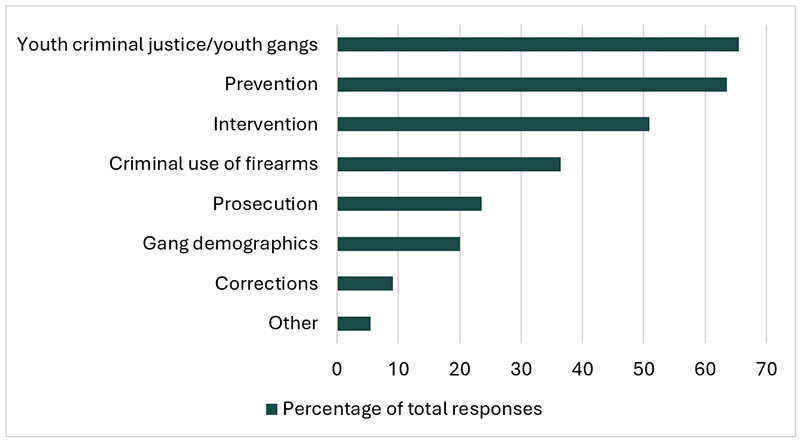
Figure 1: Descriptive text
The image shows a horizontal bar chart illustrating the percentage of total responses across various areas of research, as prioritized by respondents. The categories and their respective percentages are:
- Youth criminal justice/youth gangs: 66%
- Prevention: 64%
- Intervention: 51%
- Criminal use of firearms: 36%
- Prosecution: 24%
- Gang demographics: 20%
- Corrections: 9%
- Other: 6%
"Other" areas included research on mental health and suicide, immigration and poverty, and youth custody programming. In addition to Figure 1, some organizations expressed a desire for more resources on the following topics: 3D print manufacturing of firearms, social media, cyberbullying, and the effects of the digital media on the GGV landscape. While this may be a small percentage of the overall feedback, one detailed response introduced the concept of "digital violence accelerants," referring to social media content that incites retaliatory violence between rival groups. The respondent called for targeted policies and research to address this developing phenomenon, particularly in communities affected by cycles of gun violence.
When asked how an online repository of GGV research and resources would be useful for their work, 54 organizations responded positively. Many organizations indicated that a repository would help to build knowledge and inform strategies in their work. One response said that a repository would help their organization to "stay informed about effective programs and connect with others working toward the same goals". Another organization highlighted that a repository would also help "to establish common language" and "provide information to the public on the scope of these issues in Canada as well as [a] comparison of best practices and lessons learned by partners and experts in combatting these issues."
Insights into intervention and collaborative work
PS added five (5) questions focused on intervention work. These questions were aimed at organizations that engage in crisis intervention and response, violence interruption and/or de-escalation, building and maintaining trust and confidence among active and former gang members, and/or mediating conflicts between law enforcement, gang members, and family members. (Please See Annex A for the section of questions added to the survey.) Just over half (55%) of survey participants said that their organization worked directly with at-risk children, youth, and/or young adults. Of these organizations, 90% partner with other groups or other organizations for the purposes of intervention work, underscoring the importance of strong collaboration. The following quote highlights the central role that collaboration plays in anti-gun and gang work:
"[Our organization has] been fortunate to cultivate meaningful partnerships within our community - locally, regionally and provincially. We understand that we cannot do this work alone. These collaborations have not only strengthened our initiatives but have also revealed powerful currents of support, reminding us that collective efforts create lasting impact. True connection is built through connection and shared commitment."
Intervention work remains crucial to addressing GGV. With the addition of these new questions, PS sought to fill a gap in understanding around elements of support needed in intervention. The supports that organizations identified that would improve the effectiveness of their intervention work included increased training and education through workshops and resources, available and accessible mental health services and facilities (including addictions and substance use treatment centres), improved direct engagement and outreach, and sustainable funding. Stakeholders called on PS to provide culturally specific resources that reflect the experiences and needs of different communities across Canada.
In many intervention programs, mentors play a central role in building trust with at-risk and gang-involved youth. Mentorship programs provide positive and credible role models to vulnerable youth and young adults, offering critical support in the face of challenges. Additionally, mentorship programs rely heavily on strong partnerships with local law enforcement, mental health services, and community groups. It is through these strong partnerships that youth and young adults have access to services tailored to their needs. Ongoing training is essential to ensuring that mentors are equipped with the latest conflict resolution and trauma-informed practices. Stakeholders expressed a desire for PS to provide more information on training and best practices to inform mentorship programs. PS recognizes the opportunity and need to develop relevant and practical information to directly support training for mentorship and intervention work.
One organization highlighted the successes of specialized anti-gun and gun prosecution units and the collaboration required as part of their work. The information and knowledge sharing within these units was shared as a key strength. This respondent also shared that improved coordination, collaboration, and engagement would enhance the impacts of these units by ensuring consistency and streamlining approaches.
Implementing stakeholder feedback
Updating and improving resources
PS recognizes the decrease in the usefulness of its resources for stakeholders, representing a clear need to update and improve resources on gun and gang violence. As such, PS will integrate the feedback gathered through this survey and ongoing engagements to provide new materials and resources related to gun and gang violence over 2025-2027. Stakeholders listed information resources that their organizations use in their work, outside of PS resources. Readers can see a selection of these resources in Annex B.
Improvements for the 2025-2026 stakeholder survey
The second annual stakeholder survey introduced a module of content to fill gaps in knowledge around supports for intervention work. For the 2025-2026 survey, PS will revise this section of five (5) questions to address emerging needs and gaps in data and research.
It is PS's goal to continuously make improvements for each cycle of the stakeholder survey, including providing clearer instructions and questions for respondents. PS will keep updating its list of stakeholders underneath the ITAAGGV. If your organization would like to participate in the next annual survey, PS invites you to indicate your interest by sending an email to: ganginitiatives-initiativescontrelesgangs@ps-sp.gc.ca.
Conclusion
The second annual stakeholder survey on the ITAAGGV highlighted a range of stakeholders engaged in efforts to address GGV across Canada, with representation from NGOs, various levels of government, law enforcement, Indigenous communities, and academia. While awareness of the ITAAGGV remains relatively high, there has been an important decline in the reported usefulness of PS resources. PS is committed to updating, tailoring, and improving the availability of its resources to ensure relevance and increase usefulness. As part of these efforts, PS will also prioritize user experience and readability in the development of these resources to improve impact and reach.
The addition of questions on intervention work provided valuable insights into the supports needed to enhance effectiveness, including improved resources to better inform training and education, sustainable funding to secure program and staff capacity, and improved engagement and outreach to strengthen relationship-building and knowledge sharing. The importance of multi-sectoral collaboration was emphasized by stakeholders responsible for intervention work. Guided by the feedback in this survey, PS will also look for opportunities to foster collaboration and partnership work.
Annex A – Intervention module
25. Does your organization work directly with at-risk children, youth, and/or young adults (aged 6 to 30 years old) to intervene and instill behavioural changes that result in the reduction of criminal/gang activity?
(For example: engaging in crisis intervention and response, violence interruption and/or de-escalation, building and maintaining trust and confidence among active and former gang members, mediating conflicts between law enforcement, gang members, and family members).
Answer: Yes/No
26. What supports are needed to improve the effectiveness of this work?
Answer: Write-in
27. Does your organization partner with other groups or organizations for the purposes of this work?
Answer: Yes/No
Annex B – Selected resources shared by stakeholders
- Isaksimagit Inuusirmi Katujjiqatigiit Embrace Life Council
A non-profit organization established in 2004 through collaborative efforts and partnerships with the Government of Nunavut, Nunavut Tunngavik Incorporated, the Royal Mounted Police Service and many communities service-based providers.
- Canadian Centre for Safer Communities
The Canadian Centre for Safer Communities (CCFSC) is a community of practice created to inspire local action and foster community safety and well-being through national leadership, collaboration, capacity building, and knowledge exchange.
- Global Initiative against Transnational Organized Crime (GI-TOC) | Global Initiative
The Global Initiative comprises a network of over 600 independent global and regional experts working on human rights, democracy, governance, and development issues where organized crime has become increasingly pertinent.
- Home | National Institute of Justice
The National Institute of Justice (NIJ or the Institute) is the research, evaluation, and technology agency of the U.S. Department of Justice and is dedicated to improving knowledge and understanding of crime and justice issues through science.
- Date modified: