Evaluation of the Aboriginal Community Safety Planning Initiative
Background
The Aboriginal Community Safety Planning Initiative (ACSPI) was established in 2010 as part of the Government of Canada's efforts to address the high number of missing and murdered Indigenous women. It was renewed in 2015 as part of the Action Plan to Address Family Violence and Violent Crimes Against Indigenous Women and Girls, led by Status of Women Canada. The ACSPI was renewed again in the early 2020s. This initiative aims to help communities develop integrated approaches to community safety to address community-defined safety and well-being concerns.
The objective of the ACSPI is to support Indigenous communities to develop Community Safety Plans (CSPs) and to enhance or improve their ability to implement and sustain these plans. CSPs identify community strengths, assets and safety and wellness goals in order for all community members to see themselves involved on a path leading toward a healthy, safe home and community life.
Adopting a grass-roots approach, Public Safety Canada personnel work with communities and support them through the many stages of CSP engagement, development and implementation. Before the process starts, it is important that the community leaders fully support the concept and demonstrate commitment. Public Safety Canada personnel reach out to communities, provide information, and are available to answer questions about the Initiative and the process. However, the community safety planning process does not actually start until Public Safety Canada has been invited, and has received written endorsement from community leadership.
The ACSPI supports the community safety planning process by funding facilitation services. These facilitators run two or three planning sessions in the participating community and produce both a CSP and a final report as the final products. The Initiative also funds training for facilitators as well as travel for facilitators and Public Safety Canada personnel to communities to deliver planning sessions (although virtual facilitation was developed during the COVID-19 pandemic and remains available).
The ACSPI also supports communities after a CSP is developed. Specifically, limited funding is available to communities to implement some of the projects outlined in their CSPs (via Grants and Contributions (Gs&Cs)). Public Safety Canada personnel work with community representatives to develop projects and will also provide referrals to other programs if the activity is not covered by the Initiative or it would benefit from the participation of another partner.
Evaluation Purpose and Methodology
The purpose of the evaluation was to assess the relevance, effectiveness (achievement of outcomes) and efficiency of the ACSPI. The evaluation covered the period from fiscal year 2018-2019 to 2024-2025 and was conducted in accordance with the Treasury Board Policy on Results and the Directive on Results.
Interviews
31 key informant interviews were conducted with internal Public Safety Canada personnel, other government partners, facilitators, and community representatives.
Literature, Document and Data Review
Initiative documents and literature (e.g. government reports, facilitator reports, articles, academic research) were reviewed. Available performance data was reviewed, and financial data was analysed.
Site visit
A two-day site visit was conducted to provide evaluators with first-hand experience of the community safety planning process.
Limitations
The review of performance data was limited by the availability of information. The data were provided in excel sheets, and many indicators did not have up-to-date information or were not tracked. Interviews and documents were used to supplement the information.
Interviews with communities were planned to represent all regions and status of involvement with the program (i.e., whether the community was at the outreach stage, is actively developing a CSP, or if a CSP was developed). However, target numbers were only achieved in provinces/territories where the Initiative has been more active. Thus, community perspectives more closely represent the jurisdictions where the Initiative has funded the most CSPs. This limitation was mitigated to some extent through interviews with facilitators, who have conducted work in all jurisdictions.
Findings
Relevance
Continued Need
Finding
There is a clear, ongoing need for the ACSPI, evidenced by ongoing safety challenges, and sustained and expanding demand for the Initiative. ACSPI's Indigenous-led, capacity-building model fills a gap that is not met by other programs.
Indigenous communities continue to face persistent and disproportionate safety challenges relative to non-Indigenous populations. National data reveal that Indigenous people—especially women and 2SLGBTQIA+ individuals—experience significantly higher rates of homicide, assault, intimate partner violence, and childhood trauma than non-Indigenous people. Police-reported crime statistics from 2023 found that the homicide rate for Indigenous people overall was 9.31 per 100 000—over six times the rate for non-Indigenous people (1.46 per 100 000). These disparities can be associated with intergenerational trauma, colonial violence, and systemic socio-economic inequities, such as housing shortages, lack of emergency services, and inadequate access to culturally safe supports.
Facilitator reports corroborate these findings, highlighting widespread issues related to addictions, violence, gangs, and infrastructure gaps, and some communities declaring or considering declaring states of emergency. Interview evidence further supports that safety conditions in many communities are severe or worsening, citing the risk of drugs, human trafficking, and violence.
The sustained uptake and expanding demand for funding confirms an ongoing need for the Initiative. Since inception and until the end of the evaluation period (2024-2025), ACSPI has supported the development of 89 completed CSPs. As of March 27, 2025, there were 43 planning processes underway. All interviewees view ACSPI as highly relevant and essential. Public Safety Canada personnel characterized demand in the Initiative as growing due to referrals from other departments and interest from communities. Support for ACSPI stems from its Indigenous-led, hands-on, capacity-building approach that enables communities to set priorities and organize responses in culturally grounded ways. Furthermore, several community representatives and partners stressed that ACSPI's support remains vital, as many communities lack the resources or capacity to sustain community safety efforts independently.
Given their shared objectives of supporting Indigenous-led safety and well-being initiatives, there is some similarity with Indigenous Services Canada's Comprehensive Community Plans and the Pathways to Safe Indigenous Communities Initiative (the latter was launched in 2021 alongside the expansion of the ACSPI). However, Comprehensive Community Plans were described as typically more broad, long-term, and often underused compared to CSPs. Interviewees also noted that the process to develop a CSP is more supported, skill-building and includes accountability. As well, the Pathways initiative is expected to sunset after March 2026.
Some overlap was also suggested with select provincial initiatives (such as Ontario's municipal community safety and well-being planning requirements and Manitoba's crime-severity-based funding) by a few interviewees, although these programs are not Indigenous-specific and provide only partial support. Interviewees consistently emphasized that ACSPI's hands-on, participatory, and capacity-building model is complementary rather than duplicative.
Interviewees from partner organizations were the most likely to say directly that there is little to no overlap with other programs and described ACSPI as filling a gap in Indigenous-led, comprehensive safety planning that no other program currently provides.
Performance
Design and Implementation
Finding
The ACSPI has substantially been implemented as planned; however, progress has been slower and less consistent than expected due to community capacity limitations, administrative bottlenecks, and external disruptions that have impacted the pace of delivery and expansion.
The CSP component of the Initiative has been largely implemented as planned. CSP development and facilitation activities are ongoing across all regions and supported by ongoing outreach to communities; since 2018-2019, the Initiative has interacted with 236 communities. A facilitator network that is trained by the ACSPI to deliver CSP workshops in communities has been established; and, collaborations and partnerships to help connect communities with other support and other appropriate funding sources has been fostered.
Further, the ACSPI hosts communities of practice for community safety planners, including an annual in-person gathering for community members involved in the process to promote knowledge sharing and support continued progress. However, external factors such as the COVID-19 pandemic, crises in communities, and individual community capacity, and internal factors including Public Safety Canada human resource challenges (such as hiring delays), contracting delays within ACSPI, and facilitator availability—have affected CSP timelines and completion and the level of support provided to communities.
Progress in CSP implementation has also been slower than anticipated. ACSPI has regularly met with and sought increased collaboration with other relevant groups within Public Safety Canada and across federal departments through mechanisms such as the Indigenous Community Safety Working Group and the Interdepartmental Indigenous Community Safety, Wellness, and Justice Working Group. However, some of the interdepartmental partnerships envisioned at the outset—such as an established Memorandum of Understanding with Indigenous Services Canada's Pathways to Safe Indigenous Communities Initiative, and greater collaboration with the Northern and Indigenous Crime Prevention Fund—have not fully materialized. No specific reasons were offered to explain why these partnerships were not formalized or advanced.
Interviews highlighted that CSP implementation has been hindered by several interrelated factors, most notably community capacity limitations, including leadership turnover, competing priorities, and insufficient staffing, as well as structural constraints associated with Gs&Cs programs, such as fixed application windows, program oversubscription, and demanding application requirements. Further, most Public Safety Canada interviewees cited challenges with Vote 5/Gs&Cs funding including: strict Terms and Conditions that exclude infrastructure projects; limited Initiative personnel capacity to support contribution agreements and connect communities to other funding; and the slow start-up of use of implementation funding by communities. Collectively, these factors have limited implementation support for communities and contributed to underspending.
Gender-Based Analysis (GBA Plus)
Finding
The ACSPI's design and implementation have incorporated GBA Plus considerations, but its monitoring approach is still evolving, highlighting the need to enhance formal tracking. There are also opportunities to improve engagement with francophone, Inuit, and Métis communities and to better support those facing capacity challenges.
The needs of diverse populations have been taken into account in the design and implementation of the Initiative. ACSPI employs a distinctions-based, culturally grounded, and community-driven model, and its flexible approach enables communities to identify their own safety priorities, ensuring that community safety planning reflects diverse cultural, geographic, and socio-economic contexts. Initiative materials and guidance provided to facilitators further reinforce inclusivity principles by emphasizing barrier reduction, broad community representation, and the engagement of diverse interest holder groups—including Elders and youth—throughout safety planning processes. Interviewees widely confirmed that ACSPI is viewed as inclusive and adaptable; however, some noted that further refinement could help deepen engagement with specific groups, particularly francophone, Inuit, and Métis communities, and strengthen capacity supports to communities that may need more support.
Participation in the ACSPI and the CSP process is inclusive. Initiative data show that participation has been geographically broad, encompassing a wide range of Indigenous communities and regions, including northern and remote communities. Further, facilitator reports, and site visit observations support that CSP sessions typically involve broad community representation, including participation from diverse community organizations, Elders, and youth.
The ACSPI was originally established as part of the Government's efforts to respond to violence against Indigenous women, girls, and 2SLGBTQIA+ people, and act on some of the Calls for Justice from the National Inquiry into Missing and Murdered Indigenous Women and Girls. The ACSPI committed to tracking the quantity and diversity of community-identified solutions related to gender and gender-based violence, which would then indirectly support analysis of how safety planning is addressing the needs of women, girls, and 2SLGBTQIA+ individuals. However, no such data tracking was found through document and data review. Instead, data on gender-based violence and other community-safety priority were coded and compiled by the ACSPI team using NVivo, a specialized software that supports qualitative analysis. During the site visit, the matter of violence against women was not explicitly explored during the observed planning session.
The ACSPI has made efforts to integrate GBA Plus principles into monitoring through the use of distinctions-based datasets and a GBA Plus Data Collection and Reporting Plan. However, implementation of these remain partial and is still evolving.
Effectiveness of the Community Safety Planning Process
Finding
Most communities understand and are ready to engage in community safety planning, actively developing CSPs that address community-identified root causes and implementing activities aligned with their safety priorities. However, progress varies based on access to funding, capacity, and administrative stability within the community.
A majority of Indigenous communities that have participated in at least one planning session demonstrate a clear understanding of the CSP process and a readiness to engage. Facilitator reports indicate that a large majority of communities (89%) explicitly demonstrated an understanding of the CSP process and readiness to participate accordingly. Site visit observations corroborate these findings, noting that participants demonstrated both understanding and commitment to engage. Observations further indicate that the first workshop session effectively explains the ACSPI model and that all sessions encourage participants to ask questions and raise concerns openly, thereby minimizing the risk of misunderstandings.
Although data on this indicator is not being captured effectively, communities are engaging in the safety planning process and are developing CSPs that address the root causesFootnote 1 of community safety that the communities themselves have identified through the CSP process. Initiative data show that 46 CSPs were completed between 2018–2019 and 2024–2025, indicating active community engagement in the CSP process. Site visit observations further indicate that facilitators support communities in identifying root causes by encouraging critical thinking and the development of context-specific strategies and solutions to address community safety challenges. Based on available date, it is estimated that 75% of communities that begin the CSP process complete a plan.
Interview evidence underscores the importance of using trauma-informed approaches and sustaining relationships with communities. Lessons emerging from planning sessions conducted to date highlight the need for continued trauma-informed and culturally grounded facilitation, more consistent follow-through, and sustained relationships with communities beyond CSP completion.
Although quantitative data for this indicator are limited, qualitative evidence indicates that Indigenous communities are implementing activities aligned with their identified safety priorities. The document review found very little data tracking how many communities with CSPs are actively implementing or maintaining their plans. Nevertheless, interviews with a majority of community representatives indicate that CSP implementation is underway, with most communities acting on at least some components of their plans. Implementation efforts ranged from larger funded initiatives, such as gang prevention, land-based healing, and safety infrastructure projects, to smaller unfunded activities, such as improving networking, coordination, and resource and information sharing among community services, and incorporating CSP priorities into existing community programs.
Most community representatives reported seeking funding to support implementation, although success rates varied, and nearly half identified barriers—including rigid funding categories, limited community capacity, personnel turnover, and recruitment delays—that slowed implementation progress. Finally, a positive unintended outcome reported is that CSPs can generate benefits beyond the immediate objective of community safety planning. Across stakeholder groups, a majority of interviewees indicated that completed CSPs have enabled communities to leverage additional support or funding, mobilize broader community engagement in initiatives, and strengthen relationships and collaboration among participating groups through the planning process itself.
Effectiveness of Capacity Building
Finding
Facilitators generally have the resources and support to deliver community safety planning sessions and work with communities to develop CSPs that address the root causes of safety concerns that they identified. Areas for improvement identified by facilitators include a need for some enhancements to facilitator training and peer-learning mechanisms, and better communication with ACSPI personnel.
Facilitators are supported and work with communities
Facilitators generally have sufficient resources and support to deliver community safety planning sessions. The CSP Facilitator Guide serves as a detailed manual that outlines all steps of the CSP process and includes templates and a range of activity options, reflecting a well-resourced facilitation model. The majority of facilitators reported that Public Safety Canada's training, manuals, and annotated agendas are practical, adaptable, and effective in structuring sessions and engaging communities. In addition, a small number of facilitators emphasized the value of Public Safety Canada personnel accompaniment during sessions, citing benefits related to safety, logistical support, and emotional support when managing trauma-sensitive discussions.
Between 2018–2019 and 2024–2025, a total of 46 CSPs were completed, demonstrating sustained facilitator-supported engagement across participating communities. Site visit observations further indicate that facilitators effectively guide communities in discussions about local issues and underlying root causes, supporting the identification of context-specific strategies to be incorporated into CSPs.
Despite this, facilitators indicated that opportunities remain to strengthen facilitator training, peer-learning supports, and communication with ACSPI personnel. Some facilitators identified a need for clearer step-by-step guidance for new facilitators, re-Indigenization of the curriculum, and stronger follow-up training and peer-learning mechanisms, including a Community of Practice and the SharePoint hub. Most facilitators also reported inconsistent communication from Public Safety Canada regarding contracting, invoicing, and Initiative updates, and several recommended greater sharing of completed CSPs to enhance collective learning.
Many communities receive support to implement CSPs
Inconsistent tracking limits the Initiative's ability to accurately reflect the extent of its post-CSP development assistance in quantitative terms. However, a majority of community representative interviewed reported receiving advice, coaching, or mentoring from Public Safety Canada personnel or facilitators to support the implementation of their CSP, indicating that ACSPI is active in this area. Over half of community representative interviewees described the support they received as having been very helpful, citing clear guidance, respectful mentoring, and sustained relationships with specific Public Safety Canada personnel and facilitators.
A small number of community representatives noted that turnover among Public Safety Canada personnel disrupted the continuity of support in some cases.
Partnerships
Finding
Though the Initiative does not track partnerships effectively, partnerships are recognized as being important to the CSP process. Informal collaborations and referrals are occurring and producing positive outcomes for communities by expanding access to resources for Indigenous communities.
Service providers and Industry
There are challenges in assessing the extent to which communities are working with partners. Historical tracking data suggest that 21% of communities engaged through outreach had partnerships; however, this figure is likely understated, as partnership information has not been consistently tracked or updated over time. A review of facilitator reports indicates a higher level of partnership activity, with 39% of communities reported as maintaining or increasing partnerships, and many reports identifying partnership-building as a future priority for communities.
In contrast, interviews indicate that partnerships among Indigenous community service providers, police, and governments are occurring and are widely recognized as important to the CSP process. Interviewees reported that partnerships within communities—such as collaboration among Chiefs and Councils, Elders, youth, and education and health departments—are the most common and are viewed as essential to CSP success by fostering inclusion and grounding plans in traditional and community priorities.
Interviews also confirmed that partnerships with external actors, particularly the RCMP, local police, and government agencies, are common and encouraged as part of the CSP process, although the quality of engagement varies. Police partnerships were most frequently cited, with respondents describing both positive collaboration and challenges related to historical mistrust and inconsistent participation.
Interview findings further suggest that community capacity influences the strength and effectiveness of partnerships. Communities with greater capacity tend to form stronger partnerships, which in turn support the development of more collaborative CSPs.
Other government departments (OGD) and federal, provincial, and territorial partners (FPT)
Formal partnerships between ACSPI and OGD and FPT partners are limited and not systematically tracked; however, according to interviews, informal collaborations are occurring and have produced some positive outcomes for communities by facilitating access to additional resources. The data and document review found no evidence of formal partnership agreements or documented OGD or FPT engagements with ACSPI, and this information does not appear to be formally tracked by the Initiative. Interviews indicate that partnerships are largely informal but active, with ongoing collaboration noted with Indigenous Services Canada's Pathways initiative, select provincial arrangements such as co-funding in Yukon, and other Public Safety Canada programs. Respondents cited tangible community benefits resulting from these collaborations, including domestic violence awareness initiatives in Saskatchewan, bilingual bylaw development in Quebec, and implementation funding for under-resourced communities. In some instances, collaborations also facilitated referrals to programs delivered by other federal departments, including the Canadian Heritage, Employment and Social Development Canada, Indigenous Services Canada, and Justice Canada.
According to interviews, referrals occur regularly and support communities in accessing complementary programs; however, their effectiveness is inconsistent due to limited follow-up and broader program constraints, and referral activity is not well tracked by the Initiative. Evidence for three referrals during the evaluation period—to Northwest Territories Justice, Natural Resources Canada, and the Yukon Government—was available. Public Safety Canada interviewees reported that referrals are routine and are used to connect communities to programs or departments such as the Northern and Indigenous Crime Prevention Fund (NICPF) at Public Safety Canada, Indigenous Services Canada, and provincial or territorial governments when community needs extend beyond ACSPI's mandate. Partners also provided examples of effective regional collaboration, including Yukon's referral system and reciprocal referrals between ACSPI and the NICPF and Pathways initiative. Notably, Pathways tracked 12 referrals since 2023, four of which (33%) successfully resulted in funding. At the same time, Public Safety Canada interviewees noted that referral outcomes are often unclear due to limited follow-up, referrals to oversubscribed programs, and the administrative burden placed on lower-capacity communities. Both partners and Public Safety Canada interviewees recommended establishing a more structured, regionally coordinated referral system and strengthening engagement with additional federal programs to improve alignment with community priorities.
Efficiency
Resources
Finding
ACSPI resources have not been expended as planned, with consistent underspending driven by administrative delays, community capacity constraints, and the variable pace of community-led delivery.
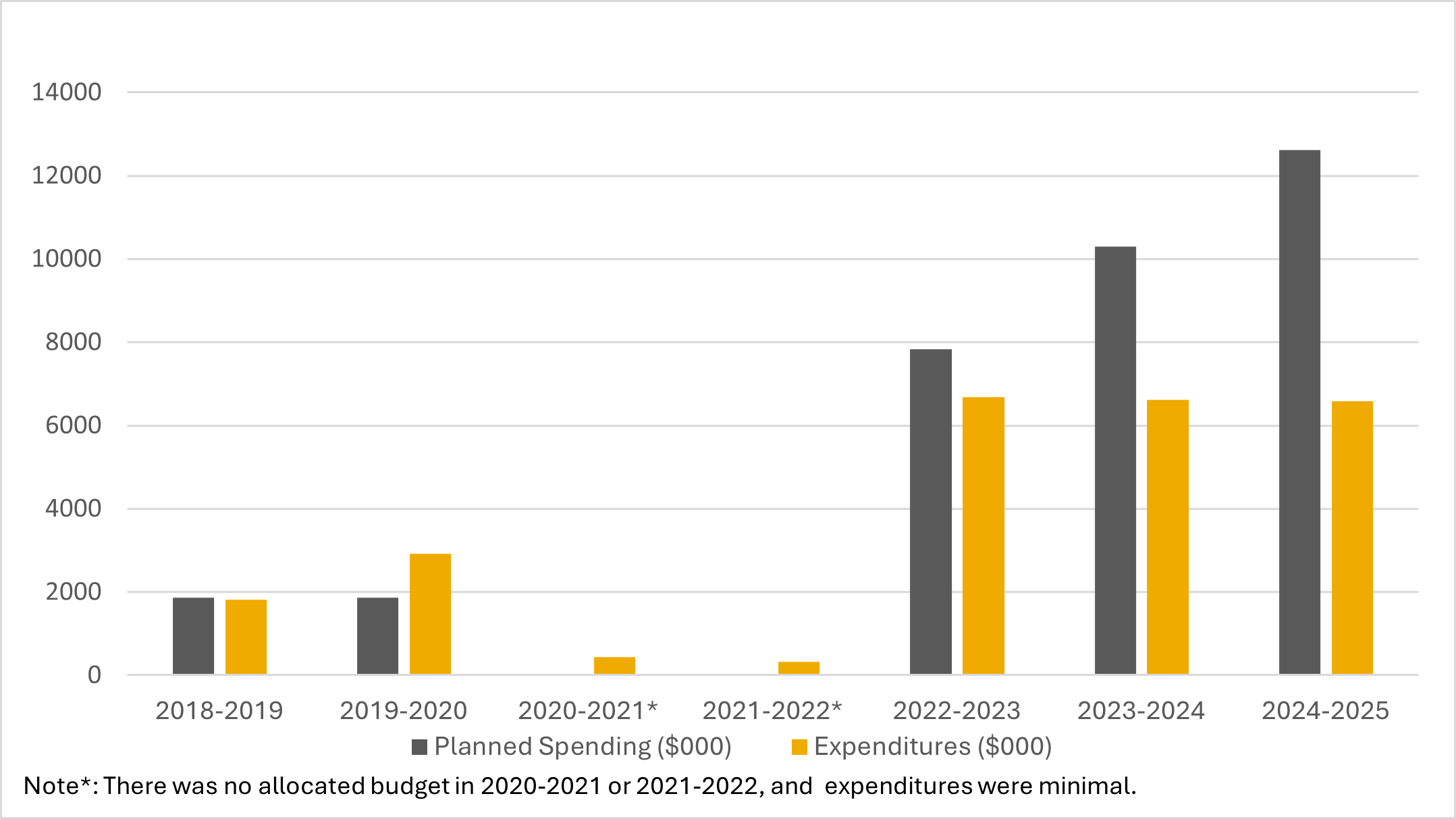
The Initiative has underspent its budget over the timeframe of the evaluation scope. Underspending began in 2022-2023 and has increased in each fiscal year since then. Variances ranged from 15% to 48% of planned spending. Over the seven years within the evaluation's scope, the Initiative underspent a total of $9.1M (26% of planned spending), including lapses in both the O&M budget of $3.7M (32% of planned spending) and in Gs&Cs spending of $5.5M (41% of planned spending).
Figure 1. Planned Spending vs expenditures
Description of Figure 1
This bar chart presents planned spending and actual expenditures by fiscal year from 2018–2019 to 2024–2025.
- In 2018–2019, planned spending was $1,869K and actual expenditures were approximately $1,812K.
- In 2019–2020, planned spending was $1,869K and actual expenditures were $2,918K.
- In 2020–2021, there was no planned spending. Actual expenditures were approximately $443K.
- In 2021–2022, there was no planned spending. Actual expenditures were approximately $331K.
- In 2022–2023, planned spending was $7,827K and actual expenditures were $6,674K.
- In 2023–2024, planned spending was $10,294K and actual expenditures were approximately $6,623K.
- In 2024–2025, planned spending was $12,611K and actual expenditures were $6,580K.
A note at the bottom of the chart indicates that there was no allocated budget in 2020–2021 or 2021–2022 and that expenditures during those years were minimal.
Community safety planning sessions are funded through O&M and CSP implementation projects are funded through Gs&Cs funding. Thus, the largest area of lapsed funding (Gs&Cs) involves the funding of projects related to the implementation of CSPs. Lapses in Gs&Cs funding are largely attributed to community readiness and capacity constraints, administrative delays in formalizing contribution agreements, and the variable pace of community-led CSP implementation due to competing priorities.
Lapses in O&M funding (supporting activities carried out by Public Safety Canada personnel and undertaking the planning sessions) are attributed to personnel vacancies and turnover at Public Safety Canada, contracting delays with facilitators, and planning activities postponed by communities.
Lessons learned and emerging best practices to strengthen efficiency without compromising community ownership have been identified. These include: supporting community capacity; having sound communication between Public Safety Canada with facilitators and communities; and ensuring alignment between ACSPI and complementary initiatives.
Over the timeframe of the evaluation, Public Safety Canada has made efforts to refine internal management with a view to improving efficiency. For example, Public Safety Canada personnel make an effort to proceed with communities that are prepared for a facilitated session rather than pressuring communities that have expressed they need more time. A number of standardized templates for communications, follow-up, etc., have also been adopted. There are also plans to modernize data systems to reduce the need for multiple spreadsheets for Initiative management.
Additional opportunities to improve resource utilization and efficiency were suggested by interviewees. These include: enhancing regional personnel, strengthening community capacity (e.g., funding dedicated CSP coordinators within communities), providing sustained support for communities after they have developed a CSP to facilitate CSP implementation, and increasing funding flexibility to accommodate community timelines.
Performance measurement
Finding
The ACSPI's current performance measurement approach is inadequate and inconsistently applied, limiting the ACSPI's ability to generate reliable and outcome-focused data.
ACSPI does not yet have effective or consistently applied processes to gather data and measure performance. According to an internal assessment in 2023, the Initiative was unable to report on nearly one-third (29%) of its indicators due to incomplete data collection or storage mechanisms. Key tools (e.g., community questionnaires) are optional and inconsistently completed. There is misalignment between data tools and performance indicators, duplication of effort, and a lack of data analysis or dissemination, with competing operational demands diverting attention from performance measurement activities.
Most Public Safety Canada interviewees stated that current information does not support data-driven management. While managers receive activity-level updates (e.g., number of CSPs, engagement status), they lack data on outcomes, implementation progress, and underlying causes of spending variances. Interviewees also noted that existing indicators are quantitative (e.g., number of CSPs, funds spent) and do not adequately capture qualitative or outcome-level information such as improved safety, capacity, or relationships.
There is no centralized system for performance measurement. The current approach is largely manual, with individual trackers and spreadsheets being used, resulting in inconsistent reporting, elevated risk of error and a limited ability to produce reliable Initiative-level analysis. Modernization efforts are underway, including the development of a SharePoint-based data platform, revised community questionnaires, and new consent form and tracking tools. However, these remain in early stages of implementation due to delays introduced by technology limitations and resource constraints.
Conclusions
The evaluation found that there is an ongoing need for ACSPI. The Initiative is complementary with other programs and responds to a gap in available supports for Indigenous-led community safety planning in Indigenous communities. ACSPI's approach as Indigenous-led, hands-on, capacity-building is unique and allows communities to set their own priorities.
ACSPI has been implemented as planned, particularly the development of CSPs whereas the implementation of CSPs has been slower than anticipated. ACSPI implementation is informed by GBA Plus (although this type of monitoring is still evolving), including taking into account the needs of diverse communities and participation is inclusive (by geography, distinctions, types of participants in planning sessions), although opportunities for improvement remain. The Initiative has made several efforts to improve Initiative delivery and provide support to both facilitators and communities. Despite this, the evaluation found that opportunities remain to further improve facilitator materials, training and community follow-up.
The Initiative has made some progress towards achieving its objectives. The community safety planning model is well-established, some partnerships are in place, and 46 CSPs were developed over the timeframe of the evaluation. The implementation of CSPs has been a challenge due to variability in support for communities after they have developed a CSP, low levels of community capacity and leadership stability, administrative and funding constraints, and variability in partnership strength and referrals.
ACSPI has recently seen persistent lapses in expenditures of both O&M and Gs&Cs funding, due to both internal and external factors. Community capacity is a common challenge in terms of having sufficient personnel to organize planning sessions and take steps to implement CSPs. Continued support to and communication with communities are important lessons to strengthen efficiency. Public Safety Canada has also made efforts to proceed with those communities that indicate they are prepared for a planning session rather than pressuring communities for which the time is not right to participate.
Further steps to increase expenditures of planned resources were suggested, including enhancing regional personnel, strengthening community capacity, providing sustained support after a CSP has been developed, and increasing funding flexibility to accommodate community timelines.
The evaluation found that ACSPI lacks an effective and consistent approach to performance measurement and tracking activities and the achievement of outcomes, resulting in gaps in reliable data available to decision-makers. Modernization efforts have begun, but suffer from delays.
Recommendations
The Senior Assistant Deputy Minister, Crime Prevention Branch should:
- Continue efforts towards modernization of performance measurement systems and data collection approaches. Explore opportunities that would accelerate implementation.
- Update facilitator materials and support, including re-Indigenization of the curriculum, facilitator training follow-up, and peer-learning supports.
- Explore options that would increase the implementation of CSPs. These efforts could focus on supporting communities to develop their capacity, along with placing an emphasis on support for communities after developing a CSP, looking for ways to increase administrative and funding flexibility, and strengthening partnerships with and referrals to other programs.
Management Action Plan
Recommendation |
Action Planned |
Planned Completion Date |
|---|---|---|
Continue efforts towards modernization of performance measurement systems and data collection approaches. Explore opportunities that would accelerate implementation. |
Continue developing the ACSPI Program Information Database (referred as the "ACSPI SharePoint site") as the new centralized "one-stop shop" for monitoring ACSPI performance data. The ACSPI Share Point site will serve as a central repository to support program planning, monitoring, and reporting. Given the technological complexity and level of effort required to develop and maintain the ACSPI SharePoint site—along with its dashboard and automated functions— ad hoc and/or ongoing technical support would be required. This support may be provided internally through collaboration with IT (at no additional cost) or through an external contractor (which would involve associated costs). |
December 2026 |
Update facilitator materials and support, including re-Indigenization of the curriculum, facilitator training follow-up, and peer-learning supports. |
Public Safety Canada (PS) staff to host an in-person working group session with existing vendor resources (facilitators) and community members/Elders who have gone through the CSP process to update the curriculum—including the facilitator guide and related materials—to ensure meaningful re-Indigenization of the content. |
March 2027 |
PS staff to host virtual peer learning and feedback sessions for all vendors and their resources to share successes and challenges twice per year. |
June 2027 |
|
Update the Standing Offer Agreement (SOA) / Statement of Work (SOW), in consultation with PS Procurement's Acquisition Advisor, to incorporate the revised documents and feedback emerging from the in-person working group session. |
December 2027 |
|
PS staff to host mandatory training (in-person or virtual) with all vendors and their resources at regular intervals to ensure that facilitators and vendors are trained and well-informed. |
June 2028 for first session |
|
Explore options that would increase the implementation of CSPs. These efforts could focus on supporting communities to develop their capacity, along with placing an emphasis on support for communities after developing a CSP, looking for ways to increase administrative and funding flexibility, and strengthening partnerships with and referrals to other programs. |
Expand the use of GCcollab to better support CSP implementation. |
October 2026 |
Revise and simplify ASCPI funding application documents. |
November 2026 |
|
PS staff to host annual proposal writing information workshops (both in-person and/or virtually) to better support CSP implementation. |
January 2027 |
|
CSP workshop delivery will be revised to better support the implementation of CSPs. An additional day will be added to Session 3 of the CSP process in order to provide guidance on the CSP implementation phase. |
February 2027 |
|
PS staff to explore piloting an initiative to fund a community coordinator who will be responsible for overseeing the CSP implementation efforts and developing/strengthening partnerships with various funders. |
March 2027 |
|
Assess CSP Action Plan implementation, identify partnership and funding opportunities for remaining or out-of-scope activities, and build relationships to support CSP implementation. |
June 2026 |
|
Review ACSDCP's Terms and Conditions and update to allow maximum flexibility. |
Approval from senior management to work on Terms and Conditions is requested before establishing a timeline |
Annex A: Expected Outcomes
The Initiative's intended outcomes are:
- Facilitators have the resources required to facilitate safety planning sessions in communities (immediate outcome) and work with communities to develop CSPs (intermediate outcome).
- Indigenous communities understand the process and are ready to engage (immediate outcome); engage in the process and develop CSPs that address root causes of community safety (intermediate outcome); and, address their community safety priorities (ultimate outcome).
- Service providers, Indigenous communities, and industry work together to address the root causes of Indigenous community safety (immediate outcome), and service providers, partners and industry adapt business practices to align with community priorities (intermediate outcome).
- OGD and FPT partners begin to develop formal partnerships with the ACSPI to address the root causes affecting community safety in communities involved with the ACSPI (immediate outcome); advance policy and services that align with community priorities (intermediate outcome); and, these have a positive impact on Indigenous communities engaged with the ACSPI (ultimate outcome).
- Communities with a safety plan are supported to implement approaches in response to their identified safety priorities (immediate outcome); implement approaches (intermediate outcome); and experience greater community safety as a result (ultimate outcome).
- Date modified: